News Flash: New Street Vendors Are Finding It Difficult to Make Money
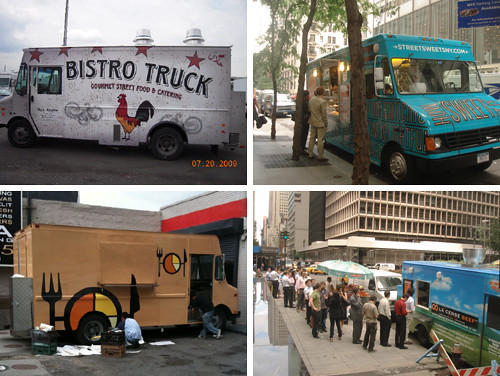
The New York Daily News is the latest media outlet to write about street vending as a legitimate money making opportunity, in an article in their money section yesterday. They’re following in the footsteps of countless other publications who have written trend pieces about the explosion in street vending here in New York City (including the Wall Street Journal, and the New York Times.) It’s refreshing to see the Daily News mention some things that the mainstream media usually ignores (like how much of an impact the weather has on business, and how important private events are to these new crop of trucks) but they still left out an important warning to entrepreneurs looking to get into this business: for all the hype that most of these vendors have generated, none of them are making real money.
On Sunday night the Street Vendor Project hosted a pre-Vendy Awards panel at the Astor Center, where Ed Levine (from Serious Eats), Kim (from the Treats Truck), Sean (from the Street Vendor Project) and I discussed a lot of the issues facing vendors today. Thomas from the Wafels and Dinges Truck, Freddie the King of Falafel, and Oleg from the Schnitzel Truck were all in the audience, and what struck me most about the discussion is the fact that none of them would recommend opening a food truck as a way to make real money. (You can read more about the event on Serious Eats.)
Mind you, this is just in New York City. In Portland, street vending actually has become a viable replacement for opening a restaurant- but that is due in large part to the fact that Portland has a large number of empty lots that owners are more than happy to rent out as permanent spaces for “street vending”. If vendors in NYC could rent their spots, and leave their trucks or carts in those spots over night, vending would be far easier, and more profitable, here. But they can’t. So it’s not.
Kogi BBQ, the Korean taco truck, proved that you can be profitable in Los Angeles, but once they researched coming to New York City decided against it. At a similar vending panel held at the StarChefs Conference in Midtown on Sunday morning, Kogi’s Chef Roi Choi said he “ran back to LA with his tail between his legs” after looking into NYC as a viable vending city. And Los Angeles might not be so easy anymore either. Now that carts are exploding there, the restaurants are starting to fight back, something I’m fearful will happen here in New York City if the current trend continues.
You’ll be hard pressed to find a guy who likes street vendors more than this guy (imagine my thumbs pointed inward as you read that), but as you know from previous posts I have grown a little concerned that the influx of new vendors might cause a new set of problems– not just for themselves, but for vending as a whole here in New York City.
The good news is I think capitalism might end up working its magic here in Midtown before the street food situation gets so crazy that brick and mortar businesses really start actively trying to shut them down. Despite all the media interest in carts and trucks, the word is finally starting to get out that selling food on the streets of NYC is not as cost effective as entrepreneurs would think. Sure, you don’t have to pay rent for your space- but you pay rent in other ways. Parking your truck at a commissary, paying for commercial kitchen space if your commissary doesn’t provide a good cooking area, expensive tickets that are unavoidable as a street vendor, plus (and possibly most importantly) you are working with less “selling” time.
A brick and mortar food establishment can open soon after you arrive at your “store”. And you can continue to prepare food all day long to meet demand. If you own a food truck, hours are spent working without selling- from prep work that can’t be done on the truck, to picking up your cart or truck, driving to the location, and finding a spot. A restaurant can serve breakfast, lunch, and dinner, plus snacks and drinks. It’s much harder for a mobile vendor to pull off that same feat.
And some of positives that many business owners see in street vending, aren’t necessarily positives at all. Once Twitter and blogs and social networking became so pervasive, many entrepreneurs saw this as just what they needed to break into the street vending scene. Using tools like Twitter you don’t have to stay in one spot. You can move around constantly, and always be able to update your fans with your location.
But what new vendors are realizing is that there is no good replacement for consistency. At the panel on Sunday night, Kim said that when she first started out the veteran street vendors warned her that moving around every day was a terrible idea. In order to make money she had to stay in the same spot every single day. New vendors would be wise to heed that advice. As indispensable a tool as Twitter is, it will never push enough customers to allow you to park in a different spot every day of the month. And carts like the Treats Truck and the Cupcake Stop Truck, who appear to move around all the time and use Twitter a great deal, still have a set schedule of places to park every single week so their customers (most of whom don’t use twitter) can depend on them being there.
In the end there is a reason street vending in New York City has always been an immigrant trade, whether it was Jews selling fish on the street to other Jews in the early part of the last century, or Middle Eastern vendors selling Halal food to Muslim taxi drivers. It’s because immigrants, who often can’t get other jobs, are willing to do the incredibly hard work of street vending for what amounts to very little money. And it doesn’t matter if you are selling hot dogs, or schnitzel, soft serve or waffles- selling food on the street is incredibly hard work for less money than you think.
If you are a chef who is incredibly passionate about opening a street vending operation, nothing should stand in your way. And the laws should be changed to make it easier for honest vendors to get licenses, and end the black market once and for all. But if you think selling food on the street, with all its automatic media coverage and great PR, is going to be a great business investment that will be cheaper and easier than opening a brick and mortar operation- you might want to do a little more research.
I spoke to Lev Ekster, the law school grad turned Cupcake Stop Truck owner, who admitted that he is using his truck to build a solid brand- but eventually hopes to expand beyond actual vending on the street, whether it’s doing more private events (which pay far more money) or even opening a brick and mortar cupcake shop. He has a word for those out there who think they are going to make a ton of money just opening a truck… “naive”.
Related:
How Twitter Actually Hurts Street Vendors
So You’re Still Thinking of Opening a Food Truck!?!
Is The Current Street Vendor Explosion Sustainable? LA Times Says Yes, I Say No.
Posted by Zach Brooks at 10:45 am, September 22nd, 2009 under Street Vendor Issues.
34 Comments | RSS comments feed for this post
34 Comments
-

-

Great article!
-

@stephen1192 – It’s hard to trust people to tell you what they actually make, but according to the Street Vendor Project, the average vendor on the streets of New York makes $14,000 to $16,000 a year.
-
Thanks Zach.
-

actually, these vendors deserve each other…..bullies it seems…not all….but ya know.
-

Bah! I had Korean BBQ tacos last night in Jersey City. Marin and Columbus, expensive but delicious.
-

CheeeeeEEEse I’m moving a couple blocks away from where that truck is parked. Can’t wait to try it.
-
Formz, where?
-
Here’s a quick uneducated back-of-the-envelope calculation:
$100,000 = start up cost (truck, equipment, etc)
$3.00 = Average profit margin on a standard lunch+drink sale (after costs associated with food/beverage, containers, napkins, utensils, gas, fuel, insurance, repairs, but excluding labor).
Assuming you can sell 75 lunches every day… (that would be one lunch unit sold every 2 min 24 secs between noon and 3pm)
75 x $3 = $225 profit/day
$225 x 5 = $1,125 profit/week
$1,125 x 52 = $58,500 profit/yearIf you use $20,000/year to pay off your start-up costs… that would leave $38,500/year to pay however many guys you need to run the truck.
I have no idea how sales/income tax gets factored in to this…
-
Clues, you never got laid in highschool, did you?
-

Rudy, you never graduated high school, did you?
-
Yup, this article just about sums it up. Even DessertTruck, which was a very high volume operation, barely posted a profit
-
Actually no, i didn’t.
I did Charterhouse though….and then 3 years sabatical at Harvard.
Political science and economics…… but no…never did get the highly rated highschool dimploma.
Tit.
-
Not sure what you’re implying with “3 years sabatical(sic) at Harvard”, Rudy. You worked at Harvard and took 3 years off to pursue being a dick? Or, you are a full-time dick who took three years off to study at Harvard?
-
CheeeeEEEEse 1st and Grove
-
Great, well written article and operating one of these is a tough business to do sucessfully. Some folks seem to think they are just a gravy train, but often that is simply not the case.
-

I really enjoyed the article Zach…
And I think the negative commenting is getting a wee bit old and incredibly ignorant.
-
Benji…ya min….do try stop being american.
-
and $50k a year?
I’d pay mama far more.
-
Formz, I’m around York and Grove.

So how much money are we actually talking about? Have any trucks released figures? Thanks!